
:: UX Design specifications for all Mobile Social projects ::
Below are more detailed presentations and write ups for selected products.
Samsung UX Innovations Lab – Family Forum::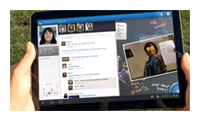 As part of Samsung UX Innovations Lab we were tasked with the challenge of creating a secure sharing network and service platform for families – where they could share important documents, access games, talk, post, and archive media from Samsung’s leading devices (TV, tablet, phone, laptop, and scaner). Exploring design paradigms for their upcoming UI’s on these hardware devices, I worked with ethnographers, businesses development, and designers to architect the core concepts and features, while also creating the main design interactions for this service suite that are seen in the concept video on the following page. As part of my work, patents on service design concepts dealing with mobile wallets and family games were filed.
Deutsches Telekom R & D – Tactful Calling ::  Tactful Calling service was released publicly Jan. 2012. After exploring women’s technology preference and service ideas – then testing them against men – it seems that Marti Barletta was correct when she said “If you meet the expectations of women. You exceed the expectations of men”. Working with a team of researchers we explored female-based service ideas for mobile phones. Examining a year and 1/2 worth of qualitative analysis of how women used mobiles, we then tested some of the top service ideas against men. Surprisingly, we aren’t so different! Narrowing the service ideas down to six solutions most viable for the market, we created new design solutions for two main concepts – Tactful Calling and Family Wheel. The process and strategy overview, as well as, a link to the Ted Global talk, given by Gesche Joost, the head of the initiative is on the next page.
Volkswagen R & D – Eco Drive ::  Please meet OttoKar! OttoKar is an in-car app designed in the Spring 2010 for Volkswagen R & D in Munich, Germany. OttoKar lives in your dashboard and mobile phone and helps drivers drive safer and green. Exploring the ideas of giving your car a personality, like a virtual pet, OttoKar rewards you for using fuel efficient acceleration speeds, car pooling, fastening your seat belt, and not driving too closely to the car ahead. The application uses the “App My Ride” SDK and combines metrics such as RPM readings with engine output to calculate gas efficiency. It uses other more socially constructed equations such as car doors shutting, with seatbelts fastening to detect ‘carpooling’. On the following page, I’ve included a demo version of the app which mimics in-car driving responses with keystrokes, as well as the full concept presentation.
Nokia R & D – Social Location Services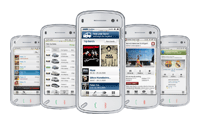 :: On September 09, 2009 Nokia announced it’s first Beta Release of Apps on Maps – a location based SDK, open to 3rd parties. As part of the team that designed this initial release and did much of the design research for the prior year leading up to it, I created design patterns, widgets, and a scalable interface metaphor to aide 3rd parties in quick creation of apps on maps. The goal of the project is to enable content providers to publish their content on all Nokia devices and across the web. As there have been many iterations of our work since this initial release, I have included a current product video here which shows screens at the time of release and my involvement and a sample product specification from some of our earlier iterations.
MetaVersum – Twinity  :: Twinity is a new 3D world which models real cities and real places. It allows players to connect through virtual parties, events, shopping, home-creating, and just hanging out. It has virtual tours and museums, for example, you can learn about the history of the Berlin wall, through visiting the wall exhibition which spans Berlin history from 1989 to 2009. The game experience is in the form of a downloadable client which ties into a web-based infrastructure. As part of their initiative to start creating more social awareness and integration, I helped to integrate Facebook, into their client and website. Along the way, we also tackled some larger interaction issues. I delivered light wireframes and agile user stories to aide the development team in implementing the designs.
scanR Mobile Applications  Product Video (Japanese): iPhone App Review
scanR is a mobile service, which ” turns your camera phone into a scanner, copier, and fax”. Utilizing the camera, this service digitizes paper, by allowing users to take photos of paper documents, business cards, receipts, whiteboards, etc and send them either via email or fax to others. On the backend, it uses advanced OCR to extract the text from the paper to make documents searchable online or transform business cards into v-cards. Making large cognitive leaps from traditional physical forms, the most challenging aspect of my work here has been creating a simple enough experience to transfer the meaning of the product to the user. The technological hurdles of working with camera phones have made this even more difficult. After three years of work on this product, I conducted many usability tests and created versions of this application to run in Java, Symbian, Brew (Verizon), Brew (pre-install on Kddi Japan phones) and the mobile web.  Business Center for the iPhone (our iPhone app) was top 5 in the productivity section of the app store.
Caterpillar Mobile – Zooke  :: Zooke is a mobile scavenger hunt framework that allows users to explore the city through interacting with user created challenges. Challenging friends and family members to notice small things about their surroundings, users can upload, share, comment, and rate mobile photos. At the same time, however, these challenges may take users on unexpected journeys throughout the city. Zooke was both my master’s thesis at UC Berkeley and the main product which sparked the creation of Caterpillar Mobile. At Caterpillar Mobile we believed that learning, discovery, and exploration didn’t only need to happen while sitting in straight rows of chairs. As such, the first implementation of Zooke was installed in the Liberty Science Center, as a children’s learning tool, from July, 2007 – July, 2010. It was a Finalist in the Vertex Innovators Challenge at UC Berkeley and received the first National Science Foundation grant of it’s kind dedicated to exploring the use of mobile technologies in informal learning settings.
Mobile Media Metadata :: In 2003, as part of Garage Cinema Research at the iSchool, University of California, Berkeley, I was the lead interface design researcher for the Mobile Media Metadata project. MMM looked at how to acquire semantically meaningful metadata via camera phone technology. Recognizing the camera phone as the first networked camera, we tried to assign spatio-temporal metadata automatically at upload. That’s to say, we tried to tag the photos automatically with who, where, when, and what action was happening in the photo. Using advanced face detection and artificial intelligence engines we used social patterning then to present users in the case of ‘best guess’ answers. As MMM2 continued to explore more social heuristic patterning this work eventually became the foundation of Yahoo! Berkeley Labs.